Introducing the Mailvio Warm-Up Tool: built for retention email, powered by Warmy.io
We just launched something we’ve been working on for months: the Mailvio Warm-Up Tool, built in close partnership with Warmy.io.
Before getting into what it does, a short detour. Warm-up is one of the most misunderstood things in retention email marketing, and most of the warm-up tools people reach for will actively wreck a domain instead of fixing it. If you already know that part, jump straight to the calculator. If you don’t, read on.
What email warm-up actually is
Email warm-up means sending small, controlled volumes of email from a new or recovering sender domain so that inbox providers like Gmail, Outlook, and Yahoo can build a positive picture of you over time.
Inbox providers don’t trust new senders. They also stop trusting senders who go silent for months and then suddenly start blasting again. Warm-up is how you tell them: I’m a legitimate sender, here’s a slow ramp of engaged email so you can build a profile on me.
There are four levels of warm-up, and they are not interchangeable.
1. IP warm-up
For dedicated IPs. Two to three months of careful execution. One mistake and you can blacklist the IP and spend months recovering. This is normally not something you have to worry about unless you have a private dedicated IP for your email sending.
2. Domain warm-up
Four to eight weeks. Required for any new sending domain, any domain that hasn’t been used in 2+ months, or any domain you’re trying to recover from a damaged sender reputation.
Note: the age of your domain also matters. If you just registered a fresh domain you should let it ‘age’ (just do nothing with it or focus on putting up a site and do some general branding and SEO). For Gmail you should wait about 1 month before starting warm-up. For other ISPs like Outlook and Yahoo they take domain age even more strict and it can take up to 1 year before deliverability starts working as normal.
3. Account warm-up
Required every single time you switch ESPs. Twelve to fifteen days. What happens if you switch email marketing platform is that the ISPs detect this (different IPs, different headers) and they ‘flag’ your sender domain for extra scrutiny (to make sure you are who you say you are). During this period you will want to make sure you slowly build up volume, you consistently sent, sent only to your most engaged users, keep the emails clean and no promo emails. It sets the foundation for trust - its like a mini restart each time you do this.
4. Campaign warm-up
Ongoing, per-campaign. Special sending patterns for bulk promotional pushes. This is the difference between consistent 20-30% open rates and consistent 30-60% open rates on the same list. This is a special feature we are working on and an extension of the highly successful and very effective ‘3 wave sending’.
Basically what it does is teach the AI of the receiving ISP that your email is good and wanted just before you send it out to your actual audience.
When you actually need warm-up
This is where most of the noise in our industry gets the story wrong, so let me be precise.
You need warm-up when you’re sending from a brand new domain. No history with inbox providers means no trust, so domain warm-up is mandatory.
You need it when you haven’t sent from a domain in 2+ months. Reputation decays. From the inbox providers’ point of view, you’re effectively a new sender again.
You need it when your domain has bad, low, or medium reputation. That scenario is called domain repair: a slower, more careful ramp designed to rebuild trust without re-triggering filters.
You need it when you’ve just migrated to a new ESP. That’s account warm-up. Every time. No exceptions.
And if you want to keep a strong reputation long-term, you want low-volume warm-up running quietly in the background alongside your normal sending. That’s domain maintenance.
There’s also a fifth scenario coming soon: Campaign Boost, a per-campaign warm-up specifically for big promotional pushes. We’re shipping it soon, so keep an eye on the calculator.
What you do not need a full warm-up for: a healthy, established domain that’s been sending consistently with strong engagement rates (25%+, > 1% CTRs, < 0.3% spam complaints and < 2% bounce rates).
You might still want a maintenance plan to keep things steady, but you’re not in a warm-up or repair situation. Don’t let anyone sell you a plan you don’t need.
Why cold email warm-up will quietly wreck retention email
Most marketers who go looking for a warm-up tool land on Instantly, Smartlead, or Lemwarm. Those tools are great. For cold outreach.
They are not built for permission-based bulk email, and pointing them at a retention sender domain actively damages your sender reputation. The mechanics are different in a way that matters.
Cold email warm-up pools are made up of cold outreach senders sending to each other. Tiny volumes per recipient, threaded reply patterns, mailbox-to-mailbox engagement signals: the whole system is engineered to look like 1-to-1 prospecting. That’s exactly what you want for cold outreach. It’s the opposite of what you want for opt-in bulk email.
Retention email is a high-volume broadcast that identifies itself properly as a bulk-campaign. The recipient mix is mostly consumer mailboxes (Gmail, Yahoo, Hotmail), not paid B2B inboxes.
When you push cold-email warm-up traffic through a domain you also use for retention email, you’re feeding inbox providers two contradictory reputation signals. The cold patterns can flag your domain as outreach. The retention patterns flag it as broadcast. Filters can’t make sense of it, and confusion defaults to suspicion.
In practice: your domain reputation degrades, open rates fall, and the warm-up tool you paid for is the cause. This is the single most expensive mistake we see marketers make.
Why the Mailvio Warm-Up Tool, not just Warmy.io directly
Warmy.io is one of the few warm-up platforms genuinely built for b2c bulk email. That’s why we partnered with them. We’ve been running real client warm-ups through Warmy for months, and we wouldn’t be building product around it if it weren’t working.
So why didn’t we just point our customers at Warmy and call it a day?
Because picking the right warm-up plan is harder than picking a tool. Warmy is powerful, and powerful means a lot of knobs to configure. If you don’t already know your way around domain reputation diagnostics, sending volume patterns, recipient provider distribution, and ramp curves, you’re guessing. And warm-up is one area where guessing gets expensive fast.
On top of that Warmy by default doesn’t properly identify the emails as bulk email campaigns, which is something our tool fixes.
The Mailvio Warm-Up Tool sits on top of Warmy and does the configuration work for you. You answer five short questions:
- What’s your domain reputation? (No reputation, bad, low, medium, high. We tell you how to figure that out.)
- What’s your goal? (Warm-up, repair, maintenance, or campaign boost.)
- What’s your average email volume?
- What’s your recipient provider mix? (Gmail / Hotmail / Yahoo / B2B, or pulled from your actual sending data.)
- Normal mode or power mode?
The tool generates a complete week-by-week plan: volume targets, daily schedule, recipient mix, and exact cost. You don’t need a spreadsheet, and you don’t need to pay $3,000 to a freelance consultant who’s right maybe 30% of the time.
Two more things worth mentioning.
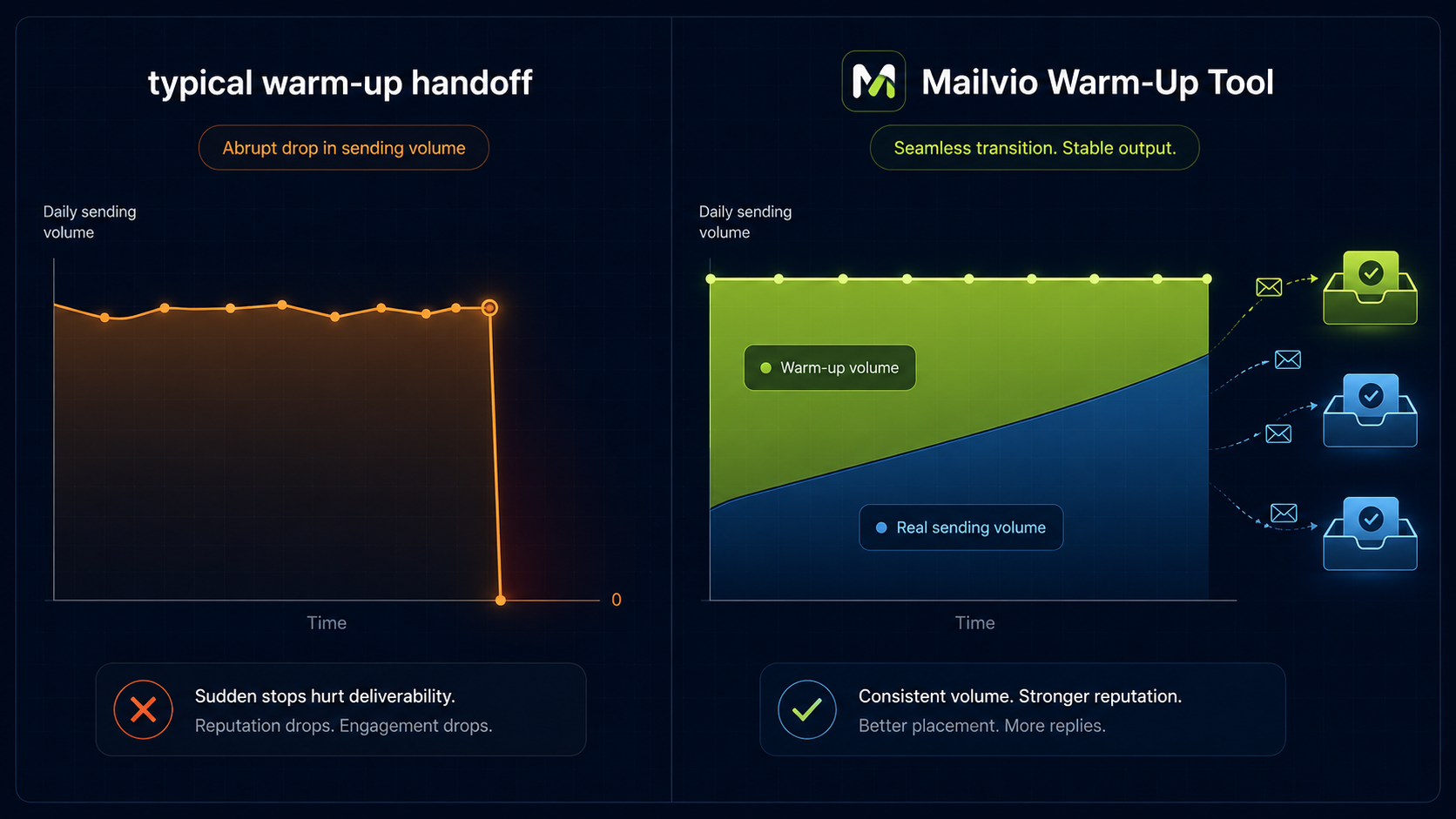
The first is ramp-down. Most warm-up services drop you off a cliff. Day 30 you’re sending 10K warm-up emails, day 31 the warm-up just stops. That sudden drop in total daily volume is exactly the kind of pattern that triggers spam filters, so your warm-up provider can wreck your reputation right at the finish line. Our tool gradually decreases warm-up volume as your real sending ramps up. Smooth handoff instead of a cliff.
The second is pricing. We don’t put a margin on warm-up. We charge what Warmy charges us. Our incentive is your deliverability, not warm-up profit. We make money when our clients succeed long-term, not by squeezing dollars out of a service we offer.
If you’re ever unsure which scenario or settings to pick, our deliverability team is one message away.
The math, if you need a number
A 100K opt-in list at $10 per subscriber per year is $1M of email revenue potential. If 90% of your sends are landing in spam (typical for an unwarmed or damaged domain), that’s $900K of potential revenue (and realistically more like 200-400K) you’re not capturing. Per year.
Warm-up runs you fractions of a cent per email. The math is not subtle.
Try it
Open the calculator at mailvio.com/done-for-you-warm-up, pick your scenario, set your volume, and you’ll get your plan and your price in under a minute.
If you want our team to handle the whole thing for you, that’s included with our higher-tier plans. Or book a call and we’ll figure out what makes sense for your setup.
And to the team at Warmy.io: thank you. Glad to be partnered with people who take retention email warm-up as seriously as we do.
Tags
Mailvio Team
The Mailvio team shares insights on email marketing, deliverability, and strategies to help you achieve better inbox placement and higher engagement.